How PPC Will (Probably) Work in ChatGPT - And What That Means for Advertisers
ChatGPT launched its first paid advertising in February 2026. It is still in its very early stages and currently restricted to enterprise-level brands with massive budgets. But it is coming - and it raises some very interesting questions about how PPC advertising is going to work, what it might mean for businesses of all sizes, and what you should be doing now to get ahead of it.
Well, the best place to start when trying to understand what advertising on ChatGPT will look like is to see what it looks like now. As I mentioned earlier in this article, ChatGPT started allowing paid advertising from 9th February 2026 - very recently at the time of writing.
There are some massive caveats before we start reading too much into this, however. The main one being there is a minimum $200,000 spend, so we are looking at enterprise brands - not Bob's Plumbing Services or a local Bognor Regis hair restoration clinic.
I connected to the US version of free ChatGPT via a VPN (I am based in the UK) to try to provoke it into showing me some screenshots of paid ads. I told ChatGPT that I fancied Mexican food for dinner and asked if it could recommend some nice spicy sauces. My first attempt didn't prompt any sponsored ads, but it did highlight something equally as important - perhaps even more overlooked - especially as it already applies in the UK and the rest of the world right now. It presents you with organic results (see below).
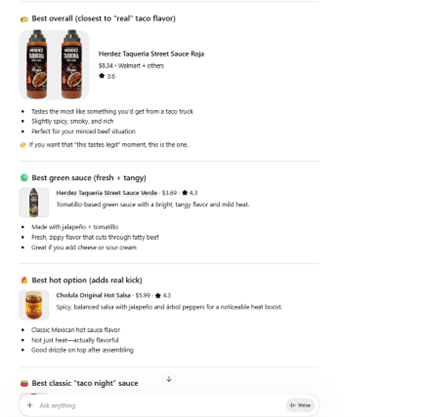
Probably a topic for another article, but ChatGPT is already recommending specific brands and products with prices, retailers, and ratings. Herdez and Cholula aren't paying a penny for that visibility - and if I was also selling delicious spicy Mexican sauce, I would want to make sure my product gets recommended too. This is something that will be of interest to SMEs in particular right now.
I tried to prompt ChatGPT into showing a sponsored ad and failed, no matter how enticing the search term - “best laptop for under $1000” and “what are the best running shoes for beginners” both failed to tempt it into giving me a sponsored ad. The rollout is genuinely very limited, still in testing, with only a small number of free tier users seeing ads at this stage.
I didn't want to disappoint you, though, so I got hold of a screenshot published by OpenAI themselves as part of their advertising announcement:
Figure 1: Source - OpenAI
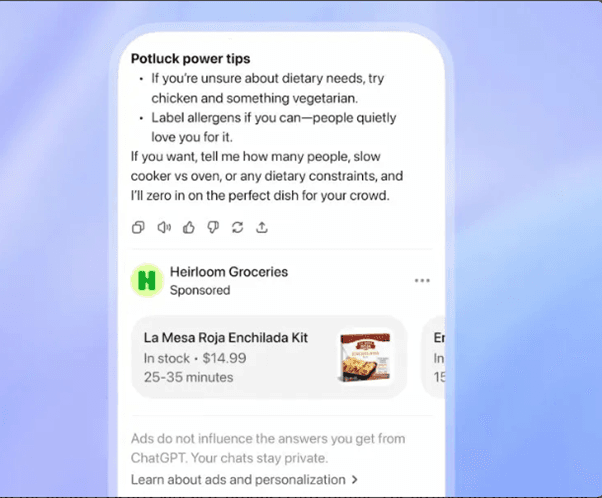
As you can see, the product card clearly shows a brand logo and “Sponsored” label - so there is no confusion that this is being recommended by the AI itself - along with the product name, price, stock status, and delivery time. OpenAI have confirmed they will not allow advertising to influence model responses. Ads are clearly labelled and clearly separated from the answer.
How effective are ChatGPT ads?
A question I bet all PPC experts and businesses using paid advertising are very keen to know the answer to.
It is early days, of course, but the data suggest that advertising on ChatGPT is extremely effective, with click-throughs five times more likely to convert than Google click-throughs.
While this is interesting and very likely to get people's attention, we have to be wary of reading too much into these stats. It is early days and from a relatively tiny sample size.
It does make sense, though. If someone is looking for running shoes on Google or Bing, they will see various sponsored ads ordered by who has bid the highest, along with a load of organic search results. They will most likely browse around, think about it, do a bit more research, and eventually make a purchase. When you ask AI a specific question, you have already been pre-sold to a degree - you are further down that decision tree. Are Brooks Adrenaline good running shoes if you have fallen arches? (I do have fallen arches.)
What happens next - and what it means for PPC
So we have had a glimpse of what ChatGPT ads might look like - a clearly labelled sponsored card with a clear demarcation between the AI answer and the paid content, leaving very little scope for confusing the two.
How the product moves forward is still somewhat speculative at this stage.
There is strong evidence from San Francisco-based technology journalism outlet The Information - based on sources inside OpenAI - that this demarcation may not remain so clear in future. One internal prototype discussed was “sponsored answers” appearing within the response itself, not below it in a separate section.
OpenAI's own wording was that they want ads to feel “useful and to fit naturally into the ChatGPT experience.” I think we can infer that the current format is a very cautious first step and it is unlikely to stay like this for long. Ad platforms tend to move toward more integrated formats over time as commercial pressure grows. Google started with clearly separated ads and they are increasingly blending with organic results.
OpenAI will have a trade-off between commercial pressure and how much trust they are prepared to risk. People look for straight, unbiased answers when they use AI and, if that trust goes, the product loses its value. There are other AI platforms such as Claude that have, so far, no plans to introduce ads. The commercial pressures are significant, though.
Similarities with Facebook
This will not be the first time there has been a shake-up in PPC. When Meta first looked to monetise and introduced ads, most people were highly sceptical that it would be a serious competitor to Google, which served highly relevant ads based primarily on search terms, intent-driven and keyword-based. Facebook, on the other hand, was a tool for connecting friends, or people you went to school with 25 years ago but haven't seen since.
Facebook felt messier - interruptive, audience-based, harder to attribute. And yet Meta, which includes Instagram as well as Facebook, has become one of the biggest advertising platforms in the world. It is not even directly competing with Google because it captures a different type of behaviour - people stumbling across something rather than looking for it.
ChatGPT will be different again and it raises some serious ethical questions.
Google knows what you were searching for. Facebook knows your friends, what you liked, and what you shared. ChatGPT could know some very intimate details about people - what problems they are trying to solve, what worries them, what they are confused about, what decisions they are wrestling with, their health concerns, relationship issues, and financial anxieties. It could build a deep psychological profile of the people it is serving ads to.
If an advertiser can target someone who has been having conversations about anxiety, debt, relationship problems, or health issues - and serve them an ad precisely calibrated to those vulnerabilities - that is a very different proposition to showing someone a running shoe ad because they searched “running shoes for beginners.” It could even be used to push a political agenda.
I am sure OpenAI are fully aware of these concerns and will work to ensure ads are matched to conversation topics rather than personal data or chat history. There is always potential for abuse, though, and it should be monitored closely.
So what does this mean for you?
This was the original question my article was trying to answer, so let us bring the conversation back to this point.
The truth is, if you are an SME managing Google Ads or Meta campaigns yourself - or managing them for clients - the honest answer is that nothing will change in the very short term. Google is here to stay and ChatGPT advertising is currently only accessible to brands spending $200,000 or more. Bob's Plumbing Services and the Bognor Regis Hair Restoration Clinic are not going to be running ChatGPT ads any time soon.
As with everything, though, time passes quickly and it pays to be prepared. The direction of travel is clear - advertising on ChatGPT and possibly other AI platforms is coming.
What can you do to prepare?
We are at the beginning of something significant. A lot fell by the wayside in the dot.com boom - many more than those that succeeded - but it produced Amazon, Google, and many other names that now dominate the trillion-dollar club. Those who were curious, adapted quickly, and stuck to the fundamentals survived and thrived. Those who failed to adapt or spread themselves too thinly did not.
A final note on Ad Optimiser
Tools like Ad Optimiser are not trying to replace ad platforms - they sit on top of them, extract the key information, put it into a format that is easy to understand, and give clear direction in plain English. The goal is straightforward: show where your ad spend is going, flag what is not working, and make those decisions clearer for people who are not PPC specialists. This need does not disappear as AI platforms enter the PPC market. If anything, it becomes more important - because as platforms get more automated and more complex, understanding what is actually working gets harder, not easier.
We are watching ChatGPT and other AI platforms evolve very closely without losing focus on existing platforms. We see the arrival of AI advertising on ChatGPT and other platforms as a fantastic opportunity - for us and our clients - not something to fear. We want you to be Netflix, not Blockbuster 😊
As AI platforms get more automated and more complex, understanding what is actually working gets harder, not easier. Ad Optimiser surfaces the issues across Google, Meta and Microsoft and tells you what to do next - in plain English.